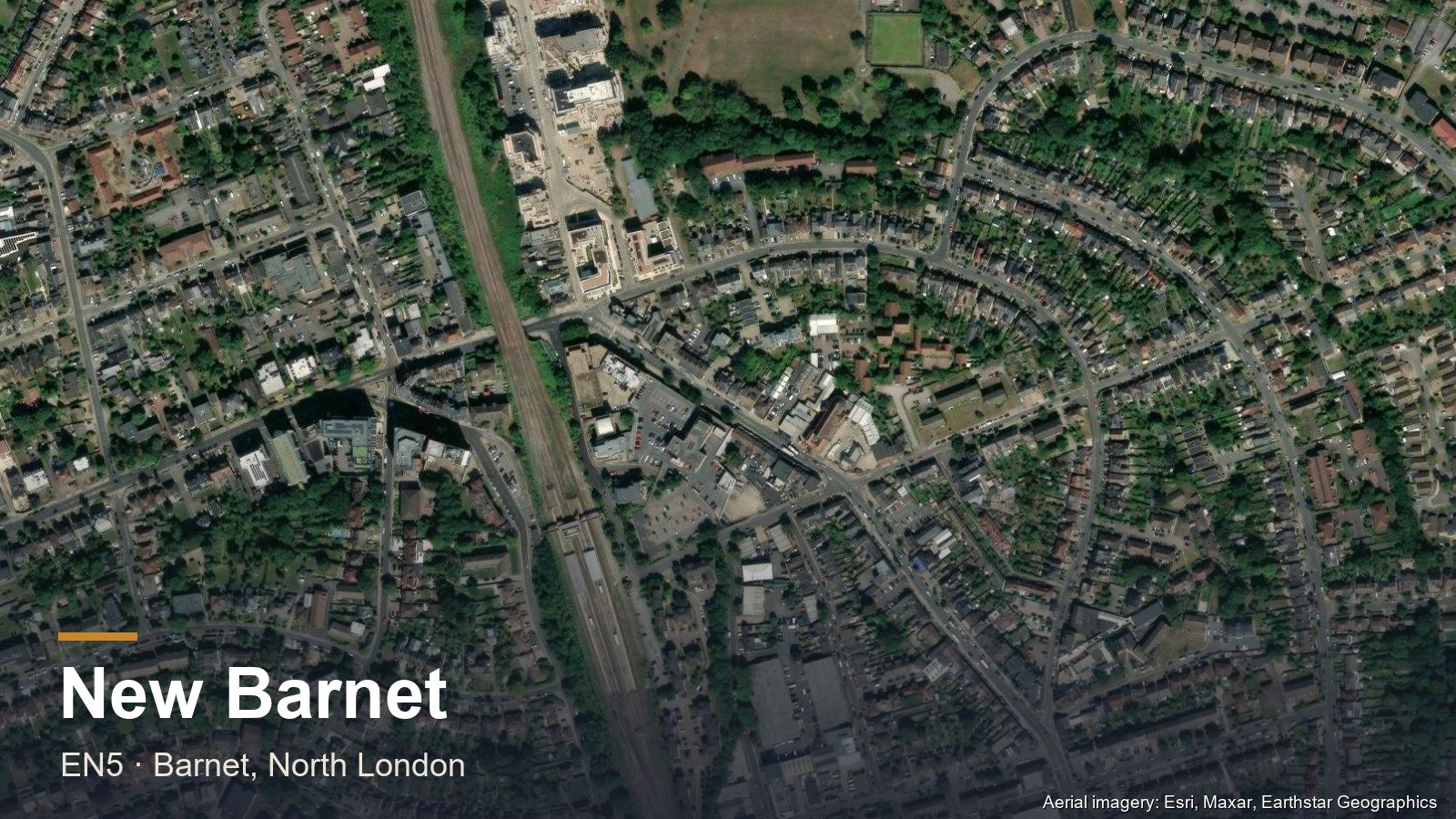
New Barnet EN4 sits between East Barnet and High Barnet, with its own railway station and a distinct mix of late-Victorian terraces, Edwardian semis and post-war infill. It's a strong loft and extension market with reasonable plot sizes and a generally pragmatic planning context outside the conservation areas.
New Barnet housing stock. Substantial late-Victorian and Edwardian semi-detached houses dominate the centre of New Barnet — large plots, generous front bay windows, original tessellated tiling in the front paths. Around the railway line and East Barnet Road, the housing stock shifts to 1930s semis and post-war terraces.
Lofts in New Barnet. The Victorian/Edwardian semis are L-shaped dormer candidates because of the original rear back-addition pattern. The 1930s semis suit straightforward rear dormers. Hip-to-gable conversions appear on the post-war hip-roofed properties.
Extensions in New Barnet. Two-storey rear extensions are increasingly common on the wider Edwardian semis — they deliver kitchen/dining downstairs plus an additional bedroom upstairs in one project. Most fall within permitted development volume allowances but conservation-area lots need a planning application.
Carpentry in New Barnet. Period detailing — restored architrave and skirting, balustrade renewal on the original Victorian staircases, alcove and chimney-breast joinery in the high-ceilinged front rooms. Bespoke kitchen work is on the rise with two-storey rear extensions opening up the ground-floor footprint.
Barnet Council Planning
New Barnet falls within London Borough of Barnet. Conservation areas include parts of the central New Barnet area and the surrounds of the railway station. Most outlying residential streets are not in a conservation area and standard PD allowances apply.
What Projects Cost in New Barnet
EN4 sits in the middle of our range — the figures below are accurate for a standard New Barnet plot.
- Rear dormer — £30,000–£50,000 on the Victorian and Edwardian terraces and the interwar semis.
- L-shaped dormer — £40,000–£60,000 where a terrace has a rear back-addition to wrap into.
- Side-return — £35,000–£55,000; single-storey rear £45,000–£75,000.
- Garage conversion — £15,000–£30,000, the cheapest way to add a room on the post-war stock.
Before You Commit
Three separate approvals govern most building work and they are routinely confused. Our guide to planning permission in Barnet covers which council decides and what falls under permitted development. Building regulations are a different approval entirely — needed for almost all structural work even when no planning permission is required — and if the job touches a shared wall or involves excavation near a boundary, you will also need a party wall agreement.
Frequently Asked Questions
How much does an extension cost in New Barnet?
A side-return runs £35,000–£55,000 and a single-storey rear extension £45,000–£75,000 for a typical 4m by 6m. EN4 sits in the middle of our range, so these figures are accurate rather than a starting point.
What loft conversion suits a New Barnet terrace?
Where the terrace has a rear back-addition, an L-shaped dormer at £40,000–£60,000 produces the best room. On a straightforward terrace or interwar semi without one, a rear dormer at £30,000–£50,000 is the usual answer.
Which council handles planning in New Barnet?
London Borough of Barnet. Most rear dormers and single-storey rear extensions fall under permitted development, and a Lawful Development Certificate is worth obtaining even where no application is needed.